
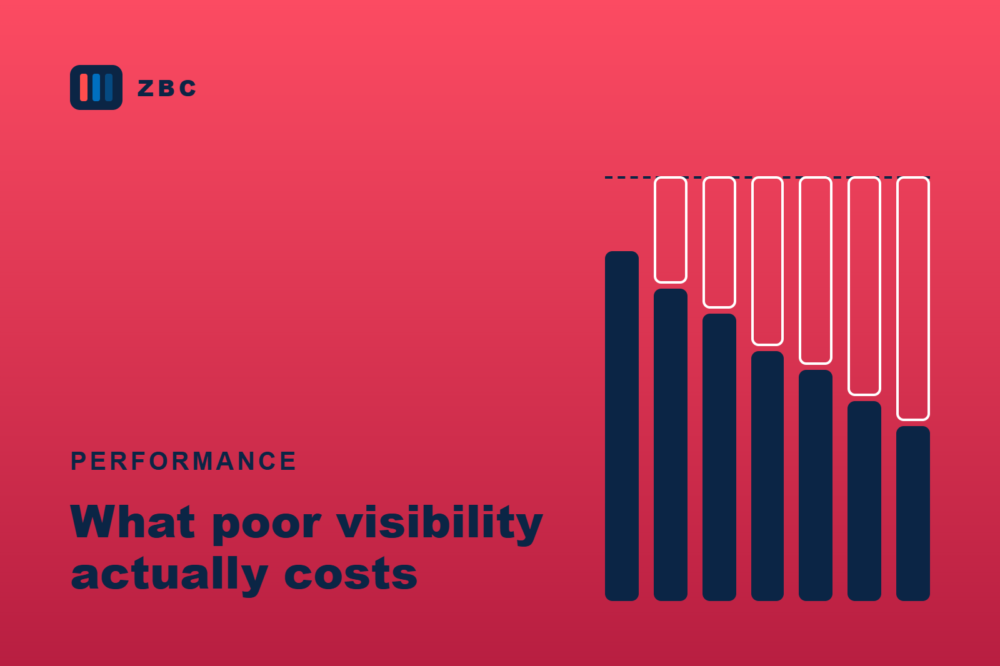
Poor data quality costs the average organisation an estimated $12.9 million a year, according to Gartner research. At the same time, businesses that genuinely embrace data-driven decision-making report 20% lower operating costs and 11% higher EBIT than their peers.
That gap is worth sitting with. It is not primarily a technology spend gap. Plenty of businesses on both sides of that statistic have comparable systems and budgets. The difference is whether a business can actually see itself clearly enough to make good decisions, and then acts on what it sees.
Most of that $12.9 million does not show up as one dramatic loss that gets noticed and investigated. It shows up as dozens of smaller ones, spread across a year and easy to miss individually. A market entered on an assumption that was never properly tested. A cost that crept up quietly over two years before anyone connected the dots. A strong-performing region that stayed underinvested because nobody could prove, with confidence, that it was actually strong.
This is what makes visibility problems expensive in a particular way: they are expensive precisely because they are invisible. Nobody gets an invoice for the decision made without the full picture. What happens instead is a slightly worse outcome than the business would otherwise have gotten, repeated many times over, across many decisions, until it adds up to a number like $12.9 million.
The organisations on the right side of that 20% and 11% gap are not necessarily spending more on technology. They have simply built the ability to see their own performance clearly enough that decisions get better over time instead of staying static.
Worth asking honestly: where do you think this kind of cost might be hiding in your own business right now, and how would you actually find out?